Virtual Tours
Palmer Lake Walking Tour
There are many buildings in Palmer Lake that date back to its beginning. Estemere has been the town’s showpiece for more than 100 years. The Old Jail has fallen into disrepair, but the Historical Society is working to move and restore this relic from the past. Several other historic buildings are included in our virtual walking tour of Palmer Lake.
|
 |
|
|
|
|
|
|
|
7. Pillsbury Store
This structure was built by Charles H.L. Pillsbury and Charles C. Pillsbury (not related) in 1886. Dr. W.F. Thompson gave the land on which the store was built as a gift, with the provision that the Pillsburys would oversee the construction and stocking of the store. William M. Younger was hired to be meat cutter and to manage the store. Ownership changed several times during the 1890’s to the Mungers, the Giem brothers and Carl Agnew. The structure is now a private residence.
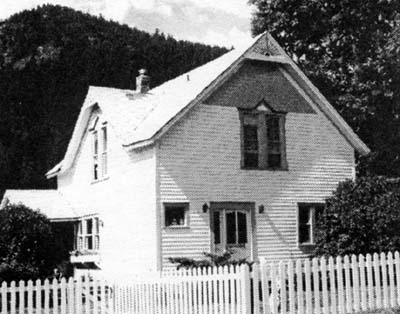
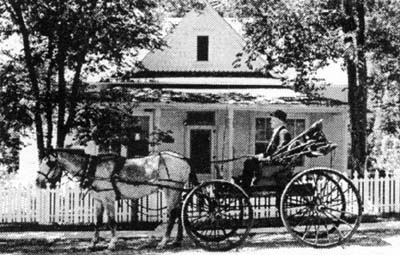
8. McIntyre Cottage and Carriage House
Dr. W.F. Thompson built the original structure in 1884 or 1885 as a club house for the Glen House Hotel–later the Rockland Hotel. The first school and church services were held here. In 1886 or 1887 it became the home of the D&RG train station agent. In 1891-1893, it became the home of Della Campbell, Postmaster, and a little post office was attached to the side of the house. The Henry A. McIntyres bought the house for a summer retreat in 1898 and in 1953 it became the retirement home of their daughter, Marian McIntyre McDonough, author and founder of the Palmer Lake Historical Society. A McIntyre grandson and his wife make the cottage their home today.
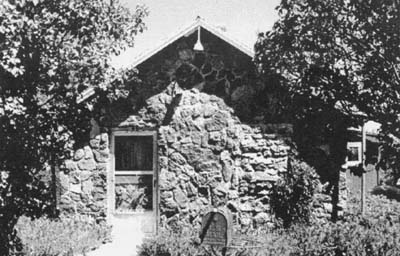
11. Electric Company and Powerhouse
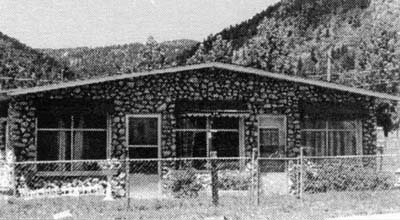
This stone structure was built in 1925 to house the town’s first electric company and generator. Mr. Jack owned the company and the Town of Palmer Lake owned the generator which provided the town’s first electric lights in 1928. The townspeople were glad to replace their flickering candles and coal oil lamps with electricity. When the Palmer Lake Star was built in 1934, electricity was still generated at this site to light the star. Fred and Mercedes Salazar resided here for over forty years until their deaths in 1996.
13. Estemere
In 1887, William Finley Thompson, a dentist from Baltimore, began building the 5,700 square-foot Estemere Estate in Palmer Lake during a period of Palmer Lake’s history referred to as the “Ambitious ’80’s.” The Victorian Mansion has 18 rooms and six fireplaces. The estate is currently undergoing a renovation by its present owners, Roger and Kim Ward. Find out more about Estemere. The Historical Society also offers a book, The Estemere Estate of Palmer Lake, for sale at the Lucretia Vaile Museum and other locations.
14. Site of the George W. Palmer House
Mr. Palmer was Dr. W.F. Thompson’s head carpenter as well as Police Magistrate, elected in 1889 by the first Town Council. His daughter, Clarabelle, was the town’s first school teacher. Mrs. C.A.J. Berry (Dr. Thompson’s sister and Town Treasurer in 1895), also once lived here. The home was torn down and replaced in 2007.
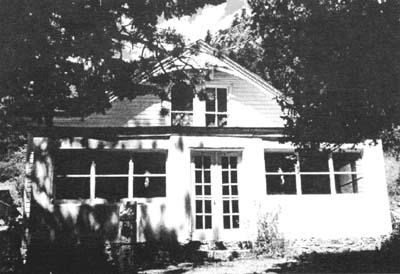
15. Vaile Log Cabin
Along with three friends, Joel Fredrick Vaile, an attorney for the Rio Grande Railroad, built the original slab wood cabin in the mountains above the Estemere Estate around 1884. The first rustic cabin consisted only of a kitchen with tents pitched under the pines, and was used as a summer retreat. The cabin was enlarged in later years and Mr. Vaile became the sole owner. Mrs. Vaile, born Charlotte White, was the author of popular books for children and did a lot of her writing at the old cabin. The Vailes had four children, one of whom was Lucretia (for whom the museum is named.
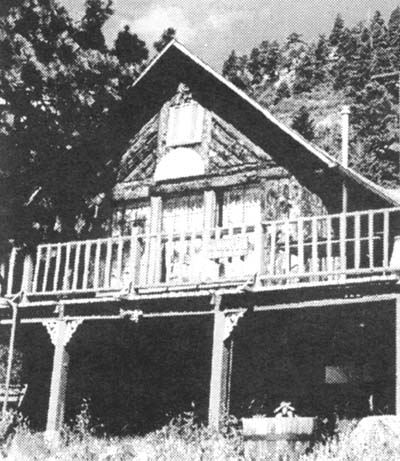
18. Telephone Office/Switchboard
The telephone company rented this house that John Woodbury erected in 1896. Because the region was a storm center, a house was needed for a man and wife who could take turns as operator. The first couple to occupy it were the Averys. The telephone company had a local “trouble-shooter” who handled many emergencies when heavy snows downed poles and wires.
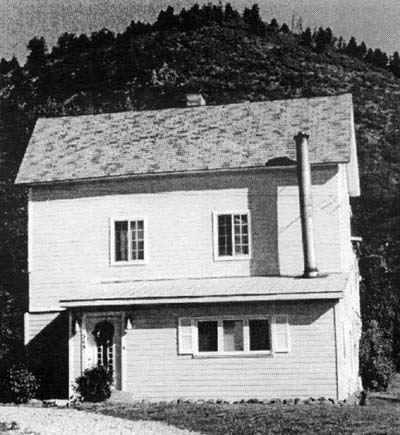
20. Little Log Church
The church was founded in 1925 as Palmer Lake Friends Community Church with 41 members. Services were held in the Town Hall until two log houses were bought which were to become the church complex. The bell in the belfry came from the first schoolhouse. Orville and Myrtle Bender were pastors until 1930. She was ordained in 1939 and remained until her retirement in 1959. The public library was located in the church until about 1964. A basement was added in 1947 which is now used for classes and social activities.
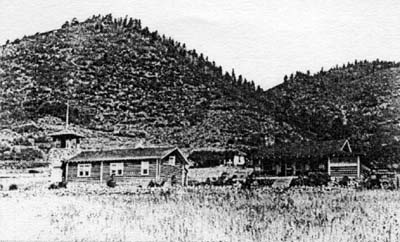
21. Countess Murat’s Cottage
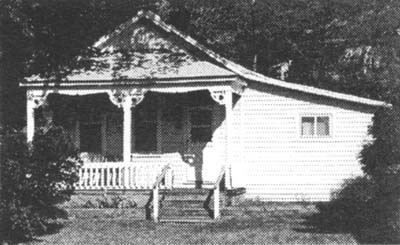
Mrs. Katrina Murat, German born, was one of Colorado’s most famous pioneer women. She and her husband became wealthy in Colorado mining, then lost their fortune. The Countess got her title through her husband, a French nobleman who was a great nephew of Napoleon. In 1887, at the age of 63, she moved to Palmer Lake and lived in the little cottage for 23 years. She was known as the Betsy Ross of Colorado Territory. Above her grave, located in Denver, is a marker which states, “‘In Memory of the Maker of the First U.S. Flag in Colorado.’ Katrina Wolf Murat 1824-1910.”
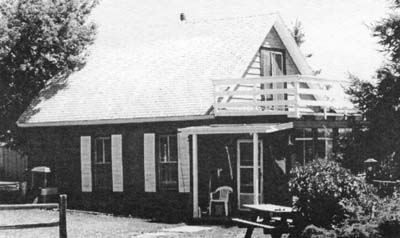
23. Old Jail
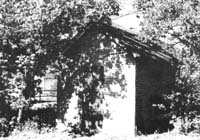
The “Calaboose” was built in 1891 by J.W. Doyle, the first watchman in Glen Park. The jail has one room with a single barred window. There were no sanitary provisions, but bedding, candles and a stove were provided to prisoners. There is a charred area inside where one inmate hoped to gain his freedom by starting a fire. The jail was used until about 1920. The old Jail is currently being repaired and is in a new location close to the Lucretia Vaile Museum. Find out more about this project.
31. Fire Station
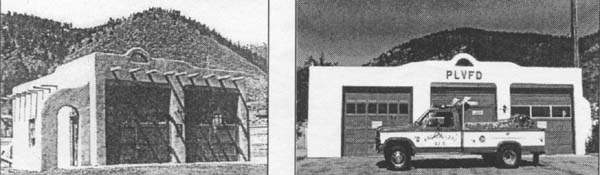
The fire station was built through a Work Projects Administration (WPA) project in 1937. The new structure, of Pueblo design, was said at the time to be one of the most up-to-date buildings in the community. An addition was completed in 1970’s,. The first Volunteer Fire Department was organized by Byron Medlock. As Captain, he purchased the first fire engines. The Palmer Lake Star was erected by these station volunteers.
42. Palmer Lake
An Army expedition, led by Colonel Henry Dodge, visited the Rocky Mountains in 1835 and mapped a body of water which they named Summit Lake. Afterward, the name changed to Divide Lake, and finally, Palmer Lake. The lake sits on the Palmer Divide where watershed drainage separates the waters of the Platte River to the north and the Arkansas River to the south. In 1872, the lake was a critical stop for the railroad as a water supply for the steam engines, as it was the only natural water supply available. Later, ice houses at the south end of the lake furnished ice by contract to the D&RG Railroad for use in “refrigerator” and dining cars. By 1882, the town began enlarging the lake to its present 10 acres. A boathouse, public park, fountain and covered pavilion were added to help attract tourists. It is believed an underground spring originally fed the lake. In dry years, water has been piped down from the two reservoirs in the canyon between Chautauqua and Sundance Mountains in which North Monument Creek flows. The reservoirs were built by the railroad to replenish the lake. Today, they serve as drinking water for the town.
Monument Walking Tour
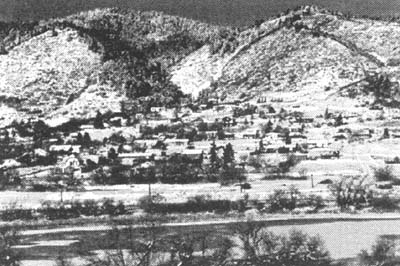
Monument began as a territorial ranching settlement in the mid 1860’s. It was first called “Henry’s Station”, after Henry “Dutch” Limbach, who ran a saloon on his homestead claim. When the Denver & Rio Grande railroad came through in 1872, the name was changed to Monument, after the prominent rock formation to the west of town. The town layout is quite typical of a 19th-century western railroad town with a “Front Street” usually parallel to the train tracks, intersected with written, numbered street names, followed by commemorative presidential names.
 |
|
 |
|
|
|
1. Limbach Park
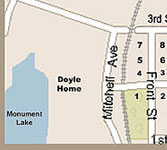
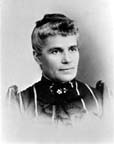
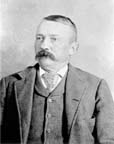
Henry Limbach platted the town site in 1874. He became the first mayor when the town incorporated in 1879. West from here was the D&RG Depot, the first school site, and present-day Monument Lake, built in 1890. Ice was harvested from the lake until the mid 1940’s. The photos are of Henry & his wife Caroline.
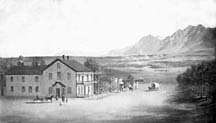
2. The Monument Hotel, 192 Front Street ca 1874
The current building was a former post office from 1975-2000. The luxurious Monument Hotel stood on this corner in 1874. It offered premier lodging at $2.00 a day, meals extra. It had nineteen rooms, furnished and carpeted. The building burned down in the early 1920’s.
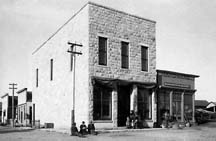
3. The Walker Store, NE corner Second & Front St. ca 1880’s
The store later housed the Monument State Bank. The building was made of quarry stone and had a 2nd floor known as “The Rod Walker Hall”. This was the hotspot for social gatherings and dances. The bank closed with a financial scandal in 1924.
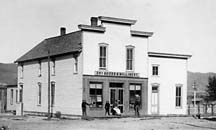
6. Limbach’s Saloon & Barber Shop, 230 Front St. ca 1869
“Henry’s Station” was the focal point of the village for decades. It did have two fatal shootings, one over cattle-rustling, and the other over the theft of a plow. Both victims died but were later found innocent. They are buried in the Monument Cemetery.
9. The Schubarth Home, 273 Washington ca 1881
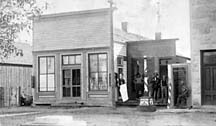
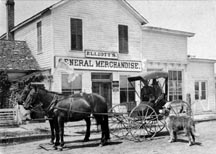
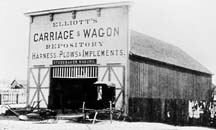
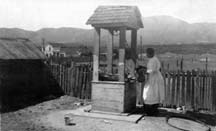
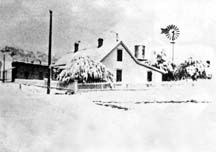
This modest house is an example of early townfolk living. Out back were the well, outhouse & barn. The family owned a couple of milking cows which supplemented their income. Mary Schubarth is seen drawing water. Note the Elliott Mercantile on the far-left.
10. Will Lierd’s Store & Caskets, 243 Washington ca 1882
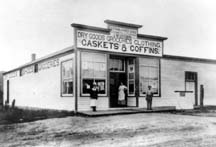
Will was called “Penny Lierd”. He always insisted on being paid to the penny. He was a rancher and carpenter. In the 1960’s – 70’s this site was home to the Monument Volunteer Fire Department. The storekeeper would sometimes act as undertaker.
18. “Big Red” or the “Lewis School”, 146 Jefferson
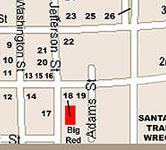
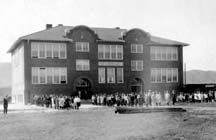
Built 1919. Designed by Mr. Thomas MacLaren, a renowned architect in early Colorado Springs and named after Inez Johnson Lewis the El Paso County Superintendent of Schools. Mrs. Lewis consolidated the one room school districts, offering a high school education here in Monument.
19. Site of the Monument Creamery, 366 Second St. ca 1900
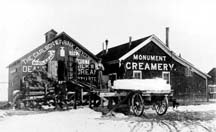
The Creamery on this site later became the Carlson & Frink Creamery. This latter company established many locations in towns along the Santa Fe Railway. Selling milk to the creamery was often the only reliable source of farm income in the winter.
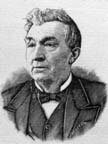
22. Sheldon Jackson Memorial Chapel, 238 Jefferson 1880
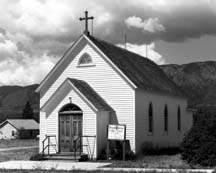
The Sheldon Jackson Memorial Chapel is the oldest church house in town. The Presbyterians founded their congregation here in 1874, with help from famed pioneer church builder, Rev. Sheldon Jackson. He established over 100 congregations throughout the American western frontier, even into the territory of Alaska.
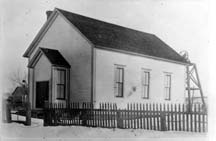
25. Santa Fe Depot, North side, Third St. at Trail crossing
Site of the Atchison Topeka & Santa Fe Depot, ca. 1887. This was the second depot for the Santa Fe line. It was moved to Hwy. 105 in the late 1940’s where it later burned. The tracks were torn up in Nov. 1974 with the rail bed later becoming the trail it is today in 1980.
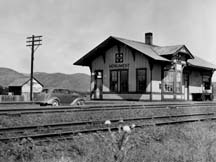
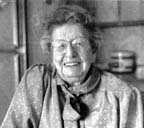
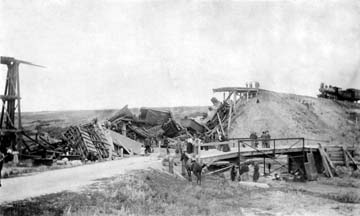
28. Santa Fe Train Wreck of 1895
Just south of 2nd Street on the Old Denver Highway a catastrophic train wreck occurred. The Santa Fe Bridge Foreman was repairing the three-hundred ft. long trestle. He removed too many cross-braces and when the train attempted to cross the trestle gave way. Six people died of injuries sustained. In 1902 the Santa Fe began replacing wood trestles with the earth structure that you see today.